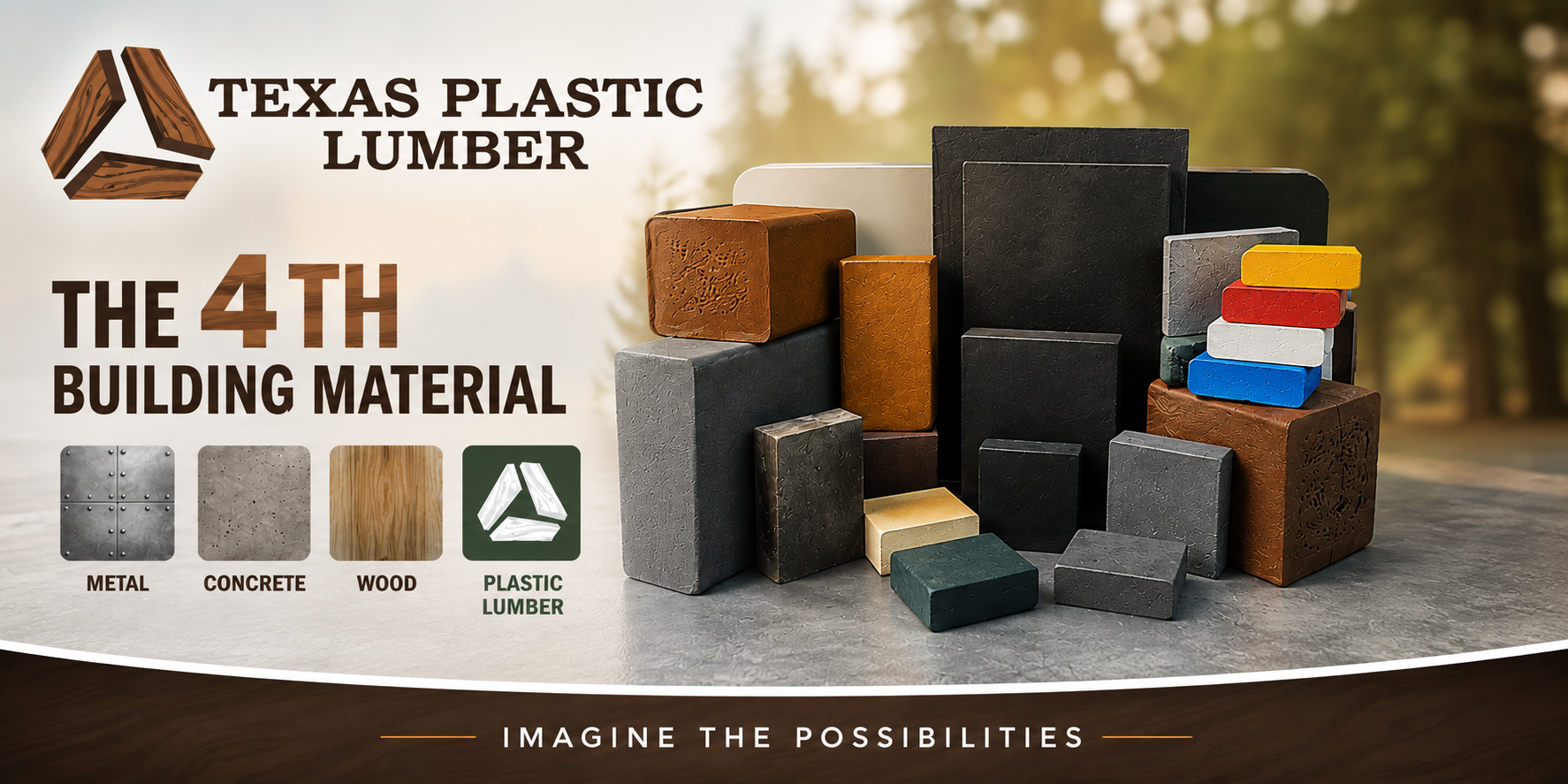
Plastic lumber isn't a single product. Different formulations are designed to perform differently, and selecting the right material involves more than choosing a board size and color.
Some plastic lumber is intended for non-structural applications such as blocking, bumpers, curbing, landscape components, wear surfaces, and other uses where the material is continuously supported or isn't required to carry significant loads. Other products are specifically engineered for structural applications where stiffness, span, load, and deflection become important.
The application determines which material makes sense.
Why Plastic Lumber Is Considered
Plastic lumber is often considered when wood is failing because of moisture, ground contact, insects, repeated maintenance or difficult environmental conditions. Depending on the formulation, it can provide a durable, low-maintenance material with no knots, splinters, rot or insect damage—and no need for painting, staining or preservative treatment.
Many plastic lumber products are manufactured with recycled plastic, helping place recovered material into long-service-life applications. Manufacturer documentation may also help project teams evaluate recycled content and potential contributions toward LEED or other sustainable-building objectives. Plastic lumber itself is not “LEED certified,” and eligibility must be determined for the particular product and project.
These benefits do not make every plastic lumber product suitable for every application. Structural capability, deflection, thermal expansion, temperature, support spacing, and fastening still have to be considered.
Start with what the material needs to do. Consider load must carry, the unsupported span, support spacing, operating temperature, environment, fastening method, dimensions, expected service life, and whether the component is structural or non-structural.
Plastic lumber also behaves differently from wood, steel, aluminum, and concrete. Understanding those differences — particularly deflection, thermal expansion, fastening, temperature, and structural capability— is important when evaluating it for an application.
You don't need to become a plastic lumber expert before contacting us. That's the purpose of this section. We'll explain the fundamentals, answer the questions that matter, and help identify the information needed to evaluate an application.
One of the most important distinctions in selecting plastic lumber is whether the application requires the material to perform structurally. Structural and non-structural plastic lumber are not interchangeable simply because they have the same dimensions.
Non-structural plastic lumber is well suited for applications where the material is continuously supported, spans relatively short distances, or isn't relied upon as a primary load-carrying component. Typical uses include blocking, spacers, curbing, wear surfaces, landscape components, equipment supports, protective components, and many replacement applications where conventional wood is deteriorating.
Structural plastic lumber is engineered for applications requiring greater stiffness and load-carrying capability. Reinforcement within the material can provide the stiffness and load-carrying capability needed in applications involving unsupported spans, framing, supports, decking, structural components, and other situations where loads and deflection must be considered.
The difference becomes especially important when a board spans between supports. Plastic lumber behaves differently from wood and steel under load. Board dimensions, unsupported span, support spacing, temperature, load distribution, and acceptable deflection all influence material selection.
A 2×6 non-structural board and a 2×6 structural board may look similar, but they should not be assumed to perform the same job.
Questions to consider: Is the material carrying a load? • What is the unsupported span? • What is the support spacing? • Is the load distributed or concentrated? • What temperatures will the material experience? • How much deflection is acceptable? • How will the material be fastened?
When structural performance matters, start with the loads and spans — not the board size.
Plastic lumber sizes are commonly described using familiar lumber dimensions such as 2×4, 2×6, 4×4, or 6×6. However, the nominal size is a product description — not necessarily the actual measured dimension of the board.
For example, a plastic lumber product described as a 2×6 may have actual dimensions different from 2 inches by 6 inches. Actual dimensions can also vary between manufacturers, product formulations, and profiles.
This becomes important when plastic lumber must fit an existing structure, align with other materials, fit within fabricated assemblies, or meet specific dimensional tolerances.
When dimensions matter, don't design from the nominal size. Confirm the actual dimensions of the specific product being considered.
Information to provide: Nominal size • required actual dimensions • acceptable tolerances • required length • existing opening or mounting dimensions • whether the material will be machined or fabricated.
When a board is supported at two or more points and carries a load between those supports, it will deflect — or bend. How much it deflects depends on the material, board dimensions, unsupported span, support spacing, load, temperature, and how that load is applied.
Plastic lumber should not be evaluated using assumptions developed for conventional wood lumber. Two boards with similar dimensions can have very different stiffness and deflection characteristics.
Span matters. Reducing the distance between supports can dramatically change how a board performs. This is why knowing crossmember, joist, or support spacing is often just as important as knowing the load.
Temperature also matters. Plastic materials become more flexible as temperature increases, so an application exposed to summer sun or elevated operating temperatures should be evaluated at the temperatures the material may actually experience.
Questions to consider: What is the unsupported span? • How far apart are the supports? • What load will the board carry? • Is the load distributed or concentrated? • What temperatures will it experience? • How much deflection is acceptable? • Is the application structural or non-structural?
Don’t start by asking, “What size board do I need?” Start with the load, span, support spacing, and temperature.
Plastic lumber expands and contracts as its temperature changes. This movement is normal, but it needs to be considered when determining board length, fastening methods, spacing, and installation details.
The amount of movement depends on the type of plastic lumber, the length of the board, the temperature range it will experience, and whether the material is structural or non-structural. Longer boards and greater temperature changes generally mean more potential movement.
Surface temperature can also be considerably different from air temperature. A board exposed to direct sunlight — particularly a darker color — can become much hotter than the surrounding air. Applications should therefore be evaluated based on the temperatures the material may actually experience, not simply the average outdoor temperature.
Structural and non-structural plastic lumber can also behave differently. Reinforcement used in some structural plastic lumber formulations can reduce thermal movement compared with some non-structural formulations. Actual thermal expansion characteristics should be confirmed for the specific product being considered.
Installation matters. Proper fastening, appropriate spacing, and allowing for expected movement can help accommodate expansion and contraction rather than trying to prevent it entirely.
Questions to consider: What temperatures will the material experience? • Will it be exposed to direct sunlight? • What color is being considered? • What is the board length? • How will the ends be constrained? • How will it be fastened? • Is space available for expansion and contraction? • Is the application structural or non-structural?
Plastic lumber moves with temperature. The objective isn't to eliminate that movement — it's to account for it in the application and installation.
Plastic lumber can be cut, drilled, and fastened using many of the same tools and methods used with conventional lumber. However, fastening should be considered as part of the application rather than simply duplicating the fastening method previously used with wood.
The appropriate fastening method depends on the type of plastic lumber, board dimensions, structural requirements, support material, loads, temperature range, and whether movement from expansion and contraction must be accommodated.
The fastener and the material work together. Screws, bolts, washers, clips, brackets, and other fastening systems may be appropriate depending on the application. Hole size, edge distance, fastener spacing, and how tightly the material is constrained can also affect performance.
When plastic lumber is attached to steel, aluminum, concrete, wood, or another material, the properties of both materials should be considered. Different materials may expand, contract, flex, or respond to loads differently.
Don't assume tighter is always better. Some applications require a rigid connection, while others may benefit from fastening details that allow controlled movement as temperatures change.
Questions to consider: What is the plastic lumber being attached to? • What loads will the connection experience? • Is the connection structural or non-structural? • What temperatures will the assembly experience? • Does the board need to move with temperature changes? • What fastener type and size are being considered? • What are the board dimensions? • Will holes be drilled in the field or during fabrication?
The goal isn't simply to attach the board. It's to create a connection appropriate for how the material will actually be used.
Plastic lumber can be cut, drilled, routed, shaped, and fabricated for many applications. This allows standard boards and profiles to be used not only as replacement lumber, but also as components incorporated into equipment, structures, and manufactured products.
Many conventional woodworking tools can be used to work with plastic lumber, but the material behaves differently from wood. Tooling, cutting speed, heat buildup, dimensional tolerances, and the specific plastic lumber formulation should be considered when machining or fabricating parts.
Start with the finished component. A required hole pattern, notch, radius, groove, bevel, cut length, or finished dimension may affect which board size or product is the best starting material.
For OEM and repeat-production applications, providing a drawing or dimensional sketch can help determine whether an available profile can be fabricated into the required component.
Questions to consider: What is the finished component? • What dimensions and tolerances are required? • Will it be cut, drilled, routed, notched, or shaped? • Are holes or mounting locations required? • What surface finish is needed? • What quantities are required? • Is the component structural or non-structural?
Sometimes the best plastic lumber solution isn't a board. It's the component you make from it.
Plastic lumber is available in a variety of colors, allowing color to become part of the material-selection process rather than relying on paint, stain, or other surface treatments.
Color can serve an aesthetic purpose, but it can also be functional. It may be used to coordinate with equipment, structures, landscaping, corporate colors, safety identification, or other components of a project.
Color can affect surface temperature. As with many outdoor materials, darker colors exposed to direct sunlight generally absorb more solar energy and can reach higher surface temperatures than lighter colors. This should be considered where people, animals, equipment, or temperature-sensitive components may contact the material.
Color availability can vary by manufacturer, product formulation, profile, and order quantity. Not every size or formulation is necessarily available in every color.